
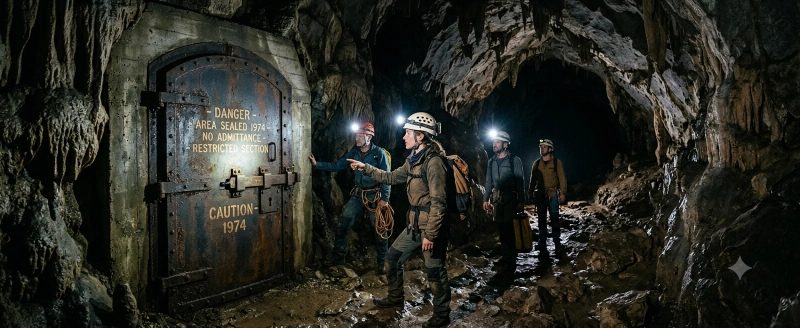
The opening wasn’t supposed to be there.
For decades, residents of a small mountain town had walked past the same rocky hillside without giving it much attention.
There were stories about caves in the area, of course.
Every old town had stories.
But according to locals, the largest cave had been sealed after a landslide nearly fifty years earlier. Nobody knew exactly how deep it went, and eventually people stopped caring.
Then another landslide changed everything.
Early one morning, a hiker noticed that part of the hillside had collapsed.
Behind the fallen rocks was a narrow black opening.
He took a photograph and posted it online.
Within days, three experienced cave explorers arrived.
What they expected to find was an old natural cave.
What they actually discovered made them turn around and contact authorities.

The First Hour Was Completely Normal
The three explorers entered shortly after sunrise.
They carried ropes, helmets, extra batteries, emergency supplies and several cameras.
The first section looked exactly as expected.
Wet limestone walls.
Pools of water.
Narrow passages.
Nothing suggested that humans had ever traveled far inside.
About forty minutes later, however, Daniel—the first explorer—noticed something unusual.
“Hold on.”
He aimed his flashlight at the ground.
There was a footprint.
A boot print.
The others gathered around.
One print wouldn’t have meant much.
Except there was another.
And another.
They continued deeper into the cave.
The prints eventually disappeared over the rocky ground.
Then they found something even stranger.
A cable.
Someone Had Installed Electricity Down There
A thick electrical cable ran along one wall.
Most of its outer coating had deteriorated, suggesting it was old.
But why would an electrical cable run deep inside a supposedly natural cave?
They followed it.
Soon, the cave began changing.
Some sections of the walls appeared unusually smooth.
Daniel ran his hand across one.
“This was cut.”
Nobody disagreed.
The passage hadn’t simply been formed by water.
At least part of it appeared to have been widened deliberately.
About ninety minutes into their exploration, they discovered the first object.
An old metal bracket attached to the wall.
Farther ahead was another.
Then another.
They appeared to have once supported lights.
Whatever this place was…
Someone had built something inside it.
Then They Found the Helmet
Almost two hours after entering, one explorer’s flashlight illuminated something white beneath a rock.
It was a construction helmet.
The plastic had yellowed with age.
A faded sticker remained on the side, but the writing was impossible to read.
Inside the helmet was a date.
1974.
That immediately caught their attention.
The cave was believed to have been sealed around the same period.
Daniel photographed it.
“Maybe this was a mine.”
It was the most logical explanation.
But there were no obvious signs of mining.
No tracks.
No abandoned carts.
No visible extraction areas.
They continued.
Then they reached something none of them expected.
A staircase.
Not rock shaped vaguely like stairs.
Actual concrete steps.
Leading downward.
The Cave Suddenly Became a Building
The temperature dropped as they descended.
At the bottom was a corridor.
Concrete had been poured over portions of the natural rock.
Rusting pipes ran across the ceiling.
Old wires hung from metal clips.
One wall contained the remains of what looked like an electrical panel.
Everything was dead.
Everything was silent.
But this was no longer simply a cave.
Someone had constructed an underground facility here.
The explorers began filming continuously.
They passed several small chambers.
Most were empty.
One contained a broken wooden table.
Another held rusted metal shelves.
Then Daniel noticed writing on the wall.
Numbers.
Arrows.
And faded letters.
Most were unreadable.
But one arrow pointed farther into the tunnel.
They followed it.
That’s when their flashlights hit the door.
A Steel Door Two Miles Underground
It was enormous.
Nearly floor to ceiling.
Unlike everything surrounding it, the door was surprisingly intact.
There was no conventional handle.
Instead, a circular locking mechanism sat near its center.
Beside it was a faded warning sign.
Daniel wiped away decades of dirt.
Only two words remained clearly visible:
AUTHORIZED PERSONNEL.
Nobody spoke for several seconds.
One explorer finally laughed nervously.
“I think this is where horror movies tell us to turn around.”
Daniel agreed.
They weren’t equipped to force open an unknown industrial door underground.
More importantly, they had no idea what might be behind it.
Chemicals.
A flooded chamber.
Unstable construction.
Or simply another empty room.
They photographed everything.
Then something happened.
A noise came from behind the door.
Clank.
All three froze.
Daniel raised his hand.
Silence.
Then—
Clank.
It sounded metallic.
Like something had moved on the other side.
Nobody suggested opening the door after that.
They Started Heading Back
The journey out felt much longer.
Every sound suddenly seemed important.
Water dripping.
Rocks shifting beneath their boots.
Air moving through the tunnel.
About twenty minutes later, Daniel stopped.
“Look.”
On the dusty ground was a footprint.
But this one looked different.
The edges were sharper.
Fresher.
One of the explorers placed his boot beside it.
It wasn’t theirs.
That didn’t necessarily mean someone was inside.
Another explorer could have entered recently.
Workers could have inspected the site.
But nobody wanted to stay and investigate.
They exited the cave and reported what they’d discovered.
Old Records Finally Offered an Explanation
Researchers began searching historical documents connected to the area.
Eventually, they found references to an infrastructure project from the 1970s.
The cave system had apparently been investigated for use as an underground storage facility.
Workers had widened tunnels, installed electrical equipment and constructed several reinforced chambers.
The project was eventually abandoned.
Soon afterward, a landslide sealed the easiest entrance.
That explained the cables.
The concrete.
The helmet.
Even the giant steel door.
But there was one frustrating problem.
None of the surviving plans clearly showed what had been constructed behind that particular door.
And the fresh-looking footprint?
Nobody could explain it.
Authorities temporarily restricted access while the structure was evaluated for safety.
The explorers never opened the door.
Daniel later admitted that people were disappointed when he told them the cave probably wasn’t a secret military bunker or hidden laboratory.
But he didn’t care.
Because he remembered standing two miles underground, staring at that steel door.
And he remembered the sound from the other side.
Maybe it was water.
Maybe shifting metal.
Maybe pressure changing inside an abandoned chamber.
There were dozens of reasonable explanations.
But Daniel always returned to the same thought:
A steel door was built to keep something either out…
Or in.